
Before the smog season began, Punjab’s environment agency put its whole winter plan on paper. The Punjab Pre-Smog Action Plan 2026 is a 32-point order that tells field officers what to inspect, what to shut down and by when, covering brick kilns, factories, vehicles, construction sites and crop burning. Signed on 5 July 2026, its continuous actions are still the operative instructions for the season now under way.
This article explains the plan in plain language: the seven parts it is divided into, the deadlines it set, who is responsible, and what it means for residents.
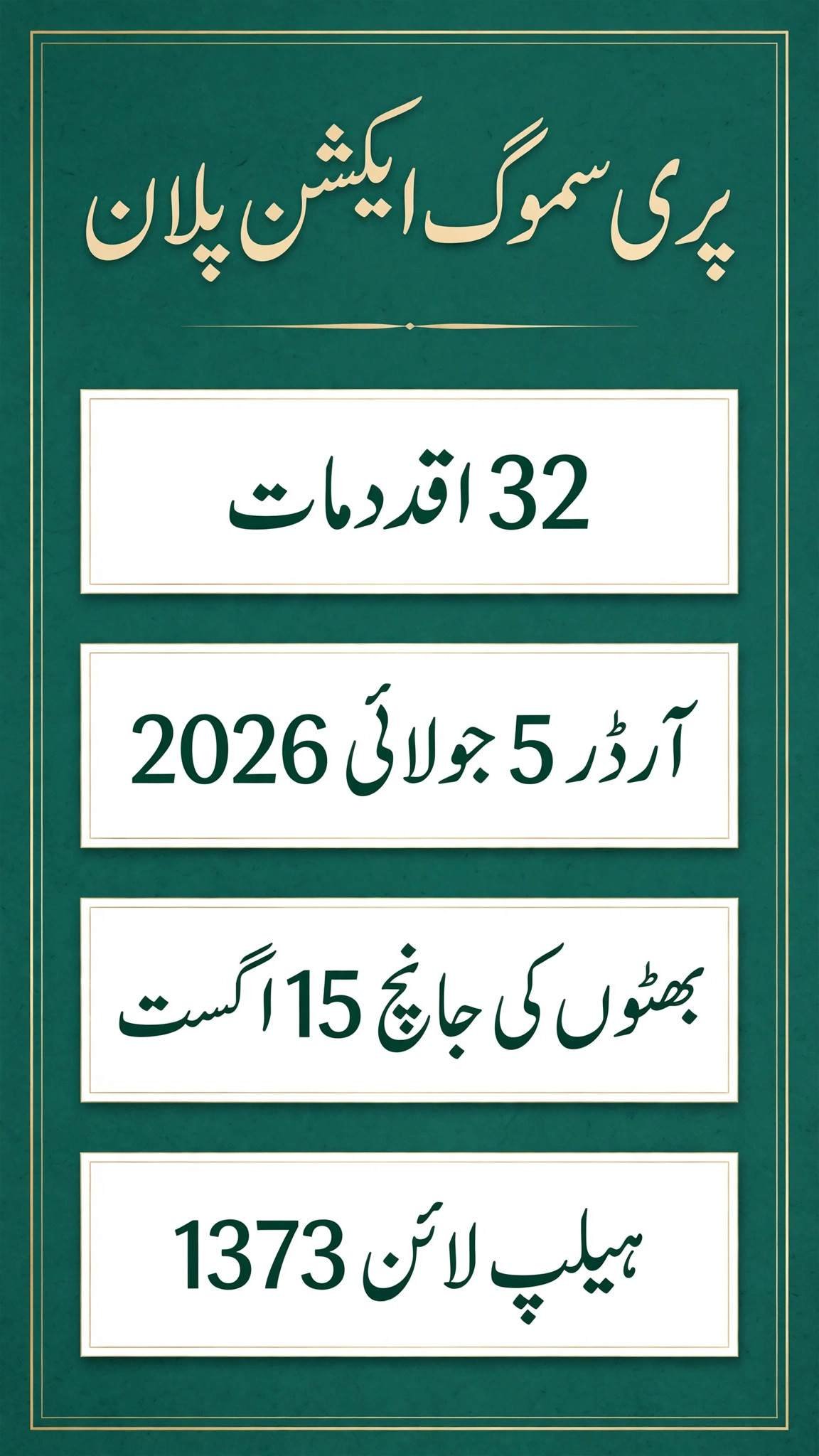
| Detail | Plan Fact |
|---|---|
| Order number | 507/PA/DG/EPA/2026 |
| Signed on | 5 July 2026, by Director General Dr Imran Hamid Sheikh |
| Coverage period | July to September 2026, with most field actions marked continuous |
| Total actions | 32 numbered actions in seven parts |
| Legal basis | Sections 6(1)(t) and 5(4), Punjab Environmental Protection Act 1997 |
| Issued by | Environmental Protection Agency, Punjab |
Planning and Coordination First
Part one deals with preparation, not punishment: the machinery the rest of the season depends on.
- Overall supervision: anti-smog operations are supervised through the EPA drone squad, which identifies pollution-causing activity.
- Provincial coordination: a provincial pre-smog coordination meeting was to be held by 30 July 2026.
- Learning from last year: previous interventions were to be evaluated by 30 July, so the same gaps were not repeated.
Inspections of Kilns and Factories
The largest part of the plan is inspection and enforcement against the major pollution sources. Brick kilns and industry sit at the top of that list, and the deadlines fell in mid-August.
- Brick kilns: kilns were to be inspected by 15 August, with pre-smog notices issued under the Act and the Smog Rules.
- Zigzag rule: kilns without zigzag technology must be demolished or sealed; about 8,000 kilns have converted to zigzag with QR codes assigned.
- Stone crushers: stone crushers were also due for inspection by 15 August.
- Restaurant hoods: suction hoods in restaurants and commercial kitchens were due by 30 July.
- Continuous checks: fuel stations, sand trolleys and construction sites are checked continuously, not on a single date.
Transport and Fuel Quality
Vehicles are one of the largest sources of urban air pollution, so the plan gives transport its own section. It links directly to the green sticker enforcement drivers now face.
- Sand and clay trolleys: field officers must ensure trolleys are properly covered under the EPA standard operating procedures.
- Smoke-emitting vehicles: smoky vehicles are checked continuously, and enforcement against them rose sharply in October 2026.
- Emission testing: exhaust testing was made mandatory, and the green sticker deadline for private vehicles is 15 November 2026.
- Cleaner fleet: Punjab has decided to buy only electric and hybrid vehicles for official use in future.
Construction Dust and Waste Burning
Dust from building sites and smoke from burning waste are two sources residents see every day. The plan treats both as continuous enforcement duties.
- Construction sites: field officers visit under-construction sites continuously to check compliance with the EPA dust procedures.
- Site controls: construction sites must use sprinklers and netting to control dust at the source.
- Open burning: open waste burning is banned, and residents can report it on helpline 1373.
- Super seeders: Punjab says it has provided 10,000 super seeders to farmers at a 60% subsidy, so the next crop can be planted without burning stubble.
Monitoring and Public Health
The final part of the plan is the one residents see every day: the AQI bulletins, the health advisories and the hospital preparation behind them.
- AQI bulletins: Action 30 requires regular AQI bulletins and public health advisories, which is the dashboard at aqi.punjab.gov.pk.
- Hourly data: the dashboard updates every hour and ranks every Punjab city by AQI.
- Hospital preparedness: the plan covers hospital preparedness with the Health Department, plus guidance on masks and school precautions.
- Twelve departments: the senior minister has said twelve government departments are working together to combat smog.
What the Plan Does Not Cover
A plan is only as strong as its gaps, and this one has a visible one. Knowing the gap matters as much as knowing the 32 actions.
- Season mismatch: the order runs July to September, yet the smog season runs to February.
- No successor order: the EPA has not published a successor order for October to December on its site as of 19 October 2026.
- No new fines: the plan sets no new fine; fines come from the Act and its rules.
- Still operative: because no successor order exists, the July to September order’s continuous actions remain the operative instructions.
| Contact and Helpline Details | Detail |
|---|---|
| Issuing authority | Environmental Protection Agency, Punjab (EPA Green Building, Gulberg-II, Lahore) |
| Plan document | Pre-Smog Action Plan 2026, Order No. 507/PA/DG/EPA/2026 |
| Live AQI | aqi.punjab.gov.pk |
Conclusion
The Punjab Pre-Smog Action Plan 2026 is the document behind this winter’s enforcement: 32 actions, seven parts, deadlines from July to mid-August, and continuous duties that run through the season. Its one clear gap is the calendar: it was written for July to September, and no successor order for October to December had been published as of 19 October. Until one appears, the plan’s continuous actions remain the rules, and helpline 1373 remains the channel for reporting violations.
FAQs
What is the Punjab Pre-Smog Action Plan 2026?
It is a 32-point EPA order (No. 507/PA/DG/EPA/2026) signed on 5 July 2026, covering inspections, enforcement and public health preparation for the smog season.
What are the seven parts of the plan?
Planning, resource mobilisation, inspection and enforcement, transport, construction and waste, monitoring, and public health.
When did the kiln inspections have to finish?
Brick kiln and stone crusher inspections were due by 15 August 2026, and restaurant suction hoods by 30 July 2026.
Is there a plan for October to December 2026?
No successor order had been published on the department’s site as of 19 October 2026, so the July to September order’s continuous actions remain operative.
How can residents report a violation of the plan?
Call helpline 1373 or report through the Green Punjab app.

The editor of epdpunjab.pk, covering the Environment Protection & Climate Change Department, Punjab and the CM Punjab Climate Leadership Development Internship Program 2026, with information verified from official sources.