Many BISP beneficiaries hear that their payment stopped because their “PMT score” went up, without anyone explaining what the score is. This guide explains it in simple words.
PMT stands for Proxy Means Test: a formula BISP uses to judge a household’s financial condition from the survey, not from self-reported income alone. The rule is short: a household generally needs a PMT score of 32 or below to remain eligible for the Kafaalat payment.
The current quarterly payment is Rs 14,500, and your status is checked by SMS to 8171 or on 8171.bisp.gov.pk.

What Goes Into Your PMT Score
- Housing standard: the type and condition of the house recorded in the survey.
- Land and assets: land, livestock, vehicles and household assets recorded for the family.
- Utility use: electricity and other utility usage, which the formula treats as a sign of spending power.
- Household size: how many people live in the household and depend on the same income.
- Work and employment: what work the household members do and what income the survey records.
None of these facts alone decides eligibility. The formula weighs them together, which is why two families with the same income can have different scores.
Why a Score Rises Above 32
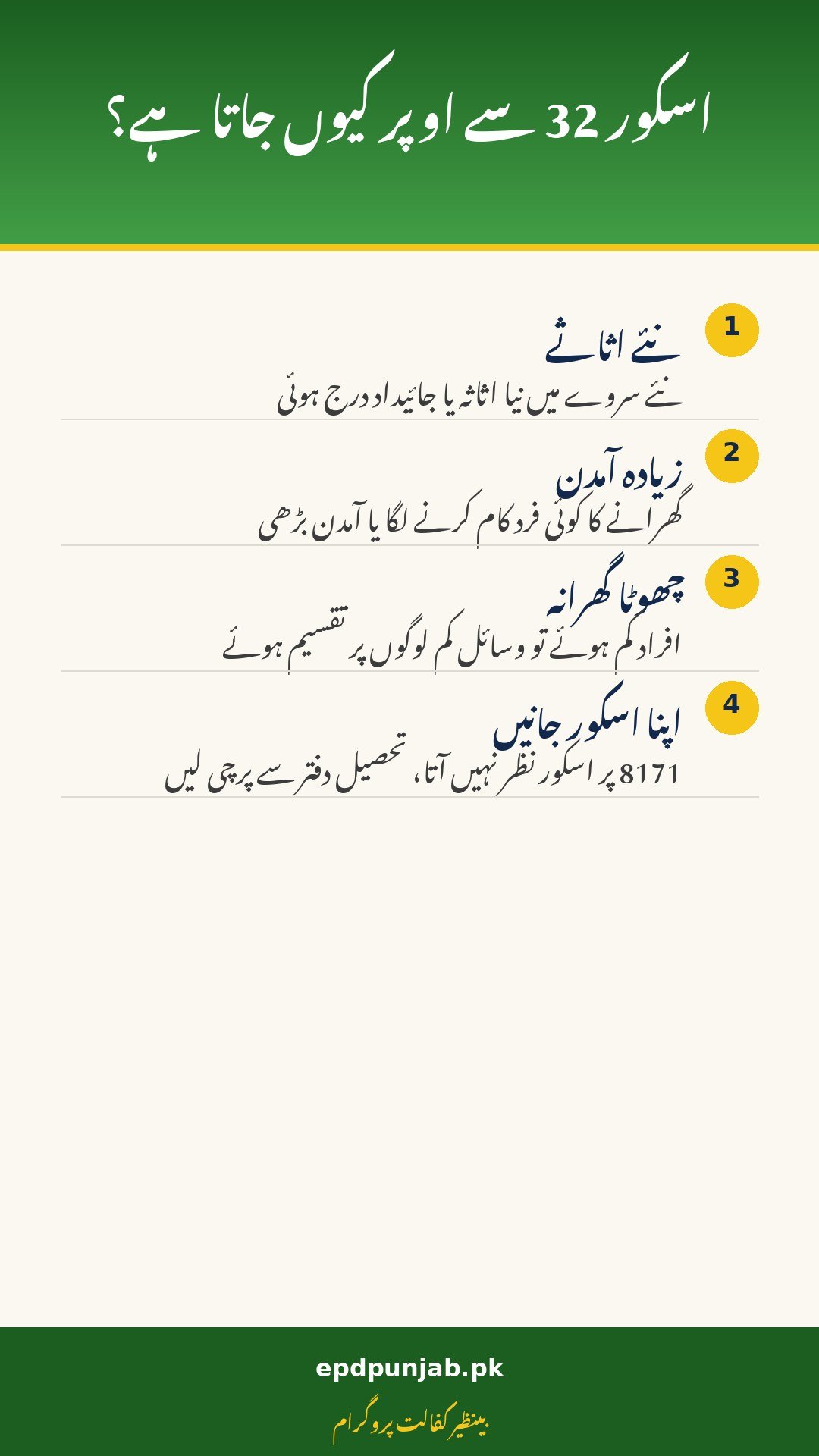
- New assets recorded: a new asset or property entered in a fresh survey raises the score.
- More income recorded: a working family member or a new income source recorded in the survey raises the score.
- Smaller household: if the survey records fewer household members — children grown up, members moved out — the same resources are spread over fewer people, and the score rises.
- Old survey corrected: sometimes a previous survey was incomplete; the corrected survey simply shows the real position, and the score follows.
How to Find Out Your Own Score
- The portal does not show it: the 8171 portal and SMS show whether a payment is released; they do not display your exact PMT score.
- Ask at the Tehsil Office: visit a BISP Tehsil Office with your original CNIC and request a PMT verification slip. That slip tells you whether the score is actually the problem.
- Do not pay for the slip: the PMT slip and every BISP service are free. Anyone charging for it should be reported on the toll-free helpline 0800-26477.
What to Do If Your Score Is Above 32
- Check the survey first: if the survey contains a wrong entry — wrong household size, wrong asset, wrong member list — correct the underlying record at NADRA where needed, then ask BISP for a re-survey with the correct facts.
- Re-survey with complete papers: carry your original CNIC, children’s B-Forms, and any corrected family record. Answer truthfully; a false entry that lowers the score temporarily will fail at the next verification.
- Appeal in writing: if you believe the score is wrong after a correct survey, submit a written appeal at the Tehsil Office with your CNIC and survey papers.
- Know the timeline: survey changes usually take effect from the following quarter, so a corrected score does not restore the current quarter’s payment immediately.
Conclusion
The PMT score is not a punishment and not a mystery. It is a formula fed by your survey, and it changes when the survey changes. If your payment stopped, find out whether the score is the reason, correct any wrong entry, and re-survey with complete papers. That is the only route back below 32 — and it costs nothing.
FAQs
- What PMT score do I need for BISP? Generally 32 or below for the Kafaalat payment. Above that, the family leaves the active beneficiary list.
- Can I see my PMT score on 8171? No. The portal and SMS show payment status only. Ask the BISP Tehsil Office for a PMT verification slip.
- Does a higher score mean I am permanently removed? Not necessarily. A corrected survey with correct facts can bring the score back down, and an appeal can be filed at the Tehsil Office.

The editor of epdpunjab.pk, covering the Environment Protection & Climate Change Department, Punjab and the CM Punjab Climate Leadership Development Internship Program 2026, with information verified from official sources.